Subscription Billing
Compare the best recurring billing software for B2B SaaS, and learn how to tell a real multi-entity billing claim from a marketing bullet before you buy.

There’s a point in the life of a B2B SaaS company when billing suddenly gets… complicated.
Maybe you’re chasing a bigger ARR target and realizing the current setup won’t comfortably get you there. Maybe a funding round is approaching, and the numbers need to stand up to rather more scrutiny. Or perhaps you’ve hired someone in finance who’s taken one look at your present operation and politely suggested that spreadsheets and crossed fingers aren’t a long-term strategy.
That’s usually when recurring billing software becomes a priority.
And to be clear, we’re not talking about tracking your own monthly bills. Nor are we talking about simply charging the same card every month – a standard payment processor can handle that perfectly well.
The real challenge starts when recurring revenue gets harder to manage: contracts change, customers expand, billing becomes more complex, and reporting has to keep pace. Add a second legal entity, for example, and ARR reporting can unravel surprisingly quickly, often right around the first consolidated close.
So, if you’re looking for hassle-free billing software that can handle all of that smartly, this guide will help you find it.
What Recurring Billing Software Actually Is
Recurring billing software calculates what each customer owes on each cycle, then passes that amount to a payment processor to collect.
But there are actually four separate jobs happening around it:
-
Payment processing moves the money.
-
Invoicing creates the document.
-
Recurring billing works out how much to charge.
-
Subscription management keeps track of the agreement over time, including what was originally agreed and what’s changed since.
There’s a useful way to tell them apart.
Did the money arrive? That’s payments.
What does the document say? Invoicing.
What should we charge? Billing.
And what did we agree, and what’s changed since? That’s subscription management.
Simple enough. But getting this distinction right early can save you a lot of wasted evaluation time.
This guide focuses specifically on recurring billing for B2B SaaS, which is a category decision that needs to come before the shortlist. Otherwise, you can spend hours comparing impressive-looking products that were never really built to solve the same problem.
What to Look For in Recurring Billing Software
Once you know you actually need recurring billing software, the next question is what separates a tool that will grow with you from one you’ll be itching to replace 18 months from now.
Six things matter most for selecting recurring billing software: Pricing-model flexibility, dunning, tax handling, revenue recognition, multi-entity support, and a self-service portal.
Pricing flexibility is a big one. B2B SaaS rarely stays neatly inside one fixed monthly fee, so a good platform should comfortably handle flat, tiered, usage-based, and hybrid pricing without forcing finance into increasingly creative workarounds.
Then there’s dunning: the retry-and-recovery process that kicks in when a customer’s card fails. It sounds like plumbing, but it has a direct impact on retention. A customer who disappears because a payment failed hasn’t chosen to leave. That’s involuntary churn, and better billing software can help stop perfectly good customers slipping out the back door.
Three tests expose the biggest differences between serious B2B billing platforms: multi-entity support, how a tool handles mid-term contract changes, and revenue recognition.
They’re also where things get rather more interesting. We’ll dive into each one separately.
How to Test a Multi-Entity Billing Claim
“Multi-entity billing” sounds reassuringly comprehensive. But before you tick that box, it’s worth finding out what the software actually means by it.
The real test is whether each legal entity can operate with its own base currency. If there’s still one company-wide currency underneath, with display conversions making everything look nicely localized, you don’t really have independent entities.
So, when a vendor says it supports multi-entity billing, dig a little deeper:
-
Can each entity have its own base currency?
-
Can the same customer be invoiced in multiple currencies while everything still reconciles to the parent’s base currency?
-
Where do the FX rates come from, and are they recalculated live during consolidation rather than frozen when the order was created?
-
Can revenue recognition rules and charts of accounts differ between entities?
-
And can a controller move from group ARR to entity, country, and individual account without taking an unscheduled detour through Excel?
Younium covers all five. Its multi-entity and multi-currency setup supports separate base currencies, with FX rates synced from sources such as the European Central Bank and consolidation calculated live rather than relying on a stale order-creation rate.
What Happens When a Contract Changes Mid-Term
When a contract changes mid-term, the tool has to credit the unused portion of the old line, issue the new one with full proration, update the revenue schedule, and keep the version history, all without anyone manually reconstructing what happened later.
Say an enterprise customer buys a twelve-month subscription, then adds 35 seats in month seven. Every step above has to happen automatically, in sequence, the moment that change is entered.
Younium handles this through order versioning. Each contract change creates a new version of the same order, with the difference captured as its own booking. Crucially, that structure is retained within the transaction itself; it isn’t an audit trail added afterward to explain what happened.
That means new business, expansion, and downsell remain cleanly separated, and won’t leave your finance team struggling to untangle them at quarter-end. Proration itself is simple arithmetic: a mid-cycle upgrade credits the unused time at the old price and charges the remaining time at the new one.
Which Revenue Recognition Standard Your Billing Uses
In Younium, the two methods differ in when the revenue schedule is generated: the ASC 606 method is order-triggered, while the IFRS 15 method is invoice-triggered. That seemingly small distinction can produce very different schedules.
Take an annual contract billed quarterly. Under ASC 606, one twelve-month revenue schedule is created when the order is placed. Under IFRS 15, the same contract produces four separate schedules, with one created for each invoice.
Younium supports revenue recognition under both ASC 606 and IFRS 15. You can set default revenue recognition rules by product and charge, override them for individual orders or customers, and trace every generated schedule back through its transaction-line audit trail.
The reason getting this right matters is that cash in the bank and recognized revenue are two different things. A company can be cash-positive while reporting a loss if that revenue hasn’t yet been recognized according to the applicable schedule.
Younium's difference from Stripe, whose separate Revenue Recognition product also supports ASC 606 and IFRS 15, sits in multi-entity operations and statutory invoicing rather than in revenue recognition itself.
The Best Recurring Billing Software Compared
|
Tool |
What it does |
Price and basis |
Multi-entity |
|---|---|---|---|
|
Younium |
Subscription management and billing for B2B SaaS on recurring and usage revenue |
Contact-us, ARR-based |
Yes |
|
Stripe Billing |
Billing layer on top of Stripe payments |
0.7% of billing volume |
Partial |
|
Chargebee |
Broad subscription management with billing, revenue recognition and retention tooling |
0% + 0.80% (pay-as-you-go) or $99/mo + 0.65% (commit) |
Yes |
|
Maxio |
Chargify billing plus SaaSOptics revenue recognition |
Grow from $599/mo (up to $100K monthly billings); Scale on quote" |
Optional module |
|
Recurly |
Subscription management focused on dunning and revenue recovery |
$249/mo + 0.9%, recognition add-on from $850/mo |
Yes (not on Starter or Pro) |
|
Paddle |
Merchant of record handling global tax and billing |
5% + $0.50 per checkout |
No |
|
Zuora |
Enterprise order-to-revenue software for complex quote-to-cash |
Contact-us |
Yes |
|
Zoho Billing |
Invoicing and subscription billing |
Subscription billing from Premium, $100/mo ($79 annual); Standard ($50/$39) is one-time invoicing only |
Partial (separate organization) |
|
BillingPlatform |
Enterprise configurable rating engine for complex usage |
Contact-us |
Yes |
|
Spreadsheets |
Manual invoicing and tracking |
Free (time cost) |
No |
Younium combines native multi-entity billing, order versioning, and revenue recognition under both ASC 606 and IFRS 15 in one platform, which matters most once a SaaS business is already crossing borders and entities. Zuora, Chargebee, and Maxio also publish multi-entity capabilities, but pricing, implementation effort, and overall scope vary considerably across the group.
Younium for B2B SaaS Finance Teams
Younium is the subscription management and billing platform for B2B SaaS finance teams whose contracts change mid-term and whose revenue crosses more than one legal entity and currency.
It handles order versioning, mid-term proration, and multi-entity consolidation natively, with ARR-based pricing tied to the recurring revenue being managed.
US sales tax runs through a TaxJar integration, VAT is handled through setup mapping for each account, and e-invoicing is available as an add-on through the Apix connector on Peppol.
Younium AI Agents, launched in September 2026, bring assistive and autonomous agents into billing operations. Its Account Validation Agent continuously checks account and billing configurations, flagging gaps that could hold up an invoice, with further agents planned for dunning and revenue recognition.
Younium earns its place once B2B contracts, entities, and currencies start multiplying, rather than in a single-entity business selling straightforward monthly plans. It isn't a payment gateway or merchant of record, and it isn't built for B2C.
Book a demo to see how order versioning and multi-entity consolidation would apply to your own contracts.
Stripe Billing
Stripe Billing is a billing layer on top of Stripe payments, covering subscriptions, proration, and metered usage, with Metronome (acquired in January 2026) sold separately as a Stripe product for more advanced usage-based billing." For developer-first teams already collecting through Stripe, it's a common starting point, priced at 0.7% of billing volume, pay as you go.
Although Stripe Revenue Recognition is a native product supporting both ASC 606 and IFRS 15, the more meaningful gap appears when businesses become more complex. Stripe Billing is weaker when revenue needs to run across multiple legal entities with statutory invoicing requirements in different countries. So for a developer-first business already happily living in Stripe, it can make plenty of sense. The question is how long the surrounding complexity stays simple enough for that setup to keep working.
Chargebee
Chargebee is one of the platforms buyers most often weigh alongside Younium and Zuora for mid-market subscription mechanics, covering billing, revenue recognition, and retention tooling, with multi-entity invoicing sold on its Enterprise plan. Its Flow plan costs $0 a month plus 0.80% of billing volume, or $99 a month plus 0.65%, with the two options breaking even at around $66K in monthly billing.
Maxio
Maxio combines Chargify billing and SaaSOptics revenue recognition, aimed squarely at fast-growth B2B SaaS finance teams. Its finance angle centers on revenue recognition and SaaS metrics alongside billing itself, and is aimed at teams who’ve outgrown basic subscription tooling and now need a clearer grip on what recurring revenue is doing across the business.
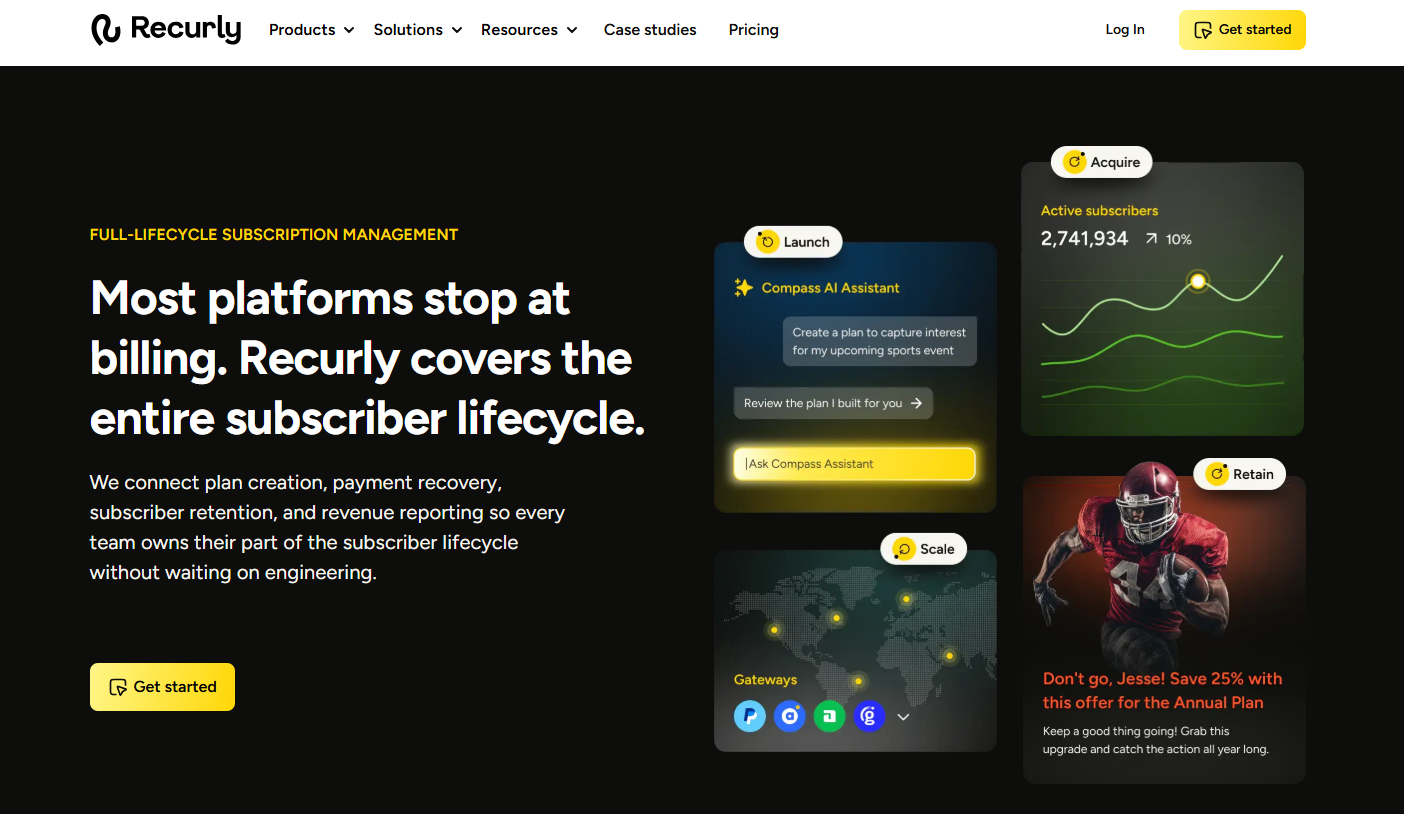
Recurly
Recurly is subscription management focused on dunning and revenue recovery. That makes it relevant when you have lots of relatively straightforward subscriptions and addressing involuntary churn is a priority. Recurly’s own network data puts SaaS churn at 3.22% overall, with 1.06% attributed to involuntary churn.
Pricing starts at $249/month plus 0.9% of billing volume, while revenue recognition is available separately from $850/month.
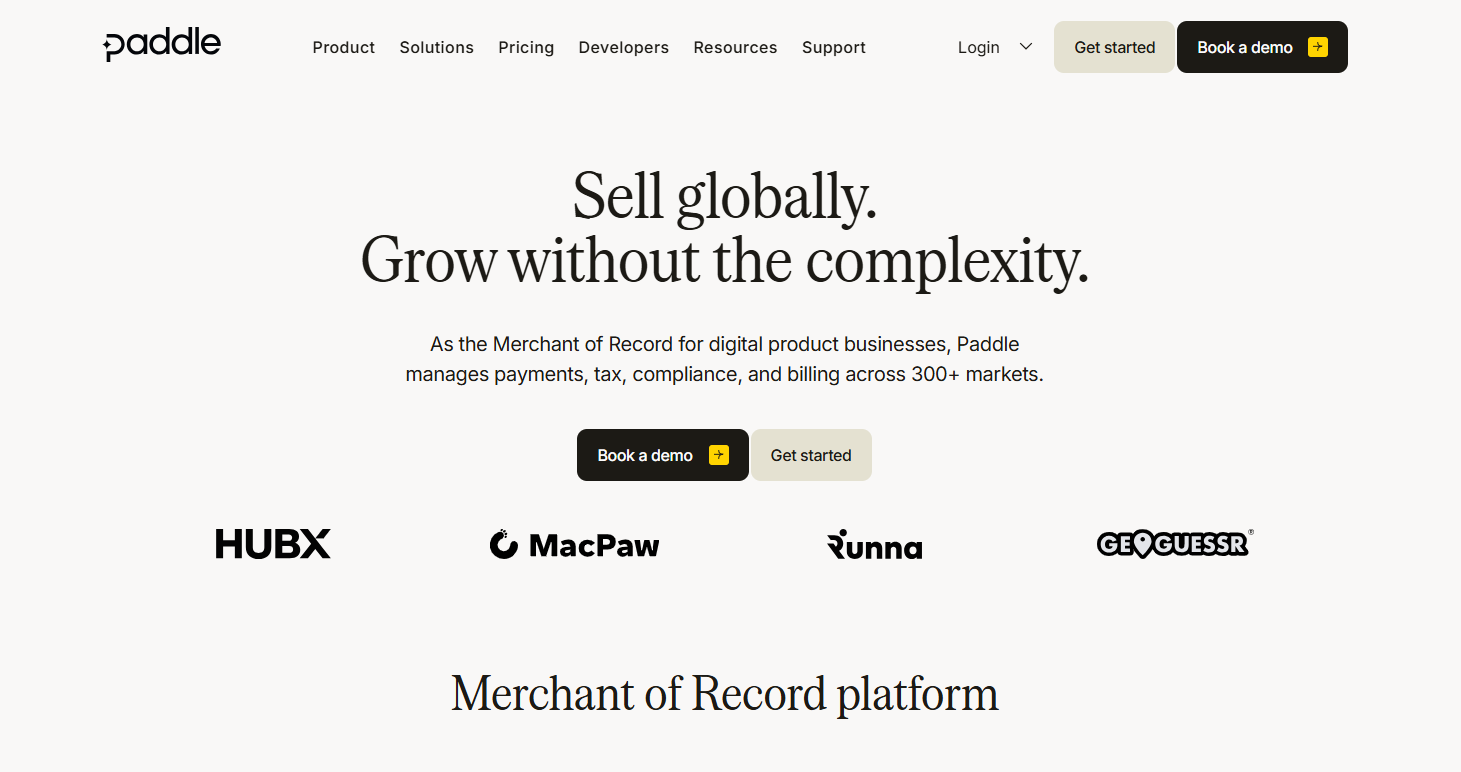
Paddle
Paddle operates as a merchant of record: it takes legal responsibility for the transaction, collecting and remitting global sales tax and VAT with billing layered on top. It helps globally sold software and self-serve businesses that would rather not hold tax registrations in dozens of countries. Operating on the other side of the processing line entirely, it's a different commercial model rather than a like-for-like billing platform, priced at 5% plus 50 cents per checkout transaction.
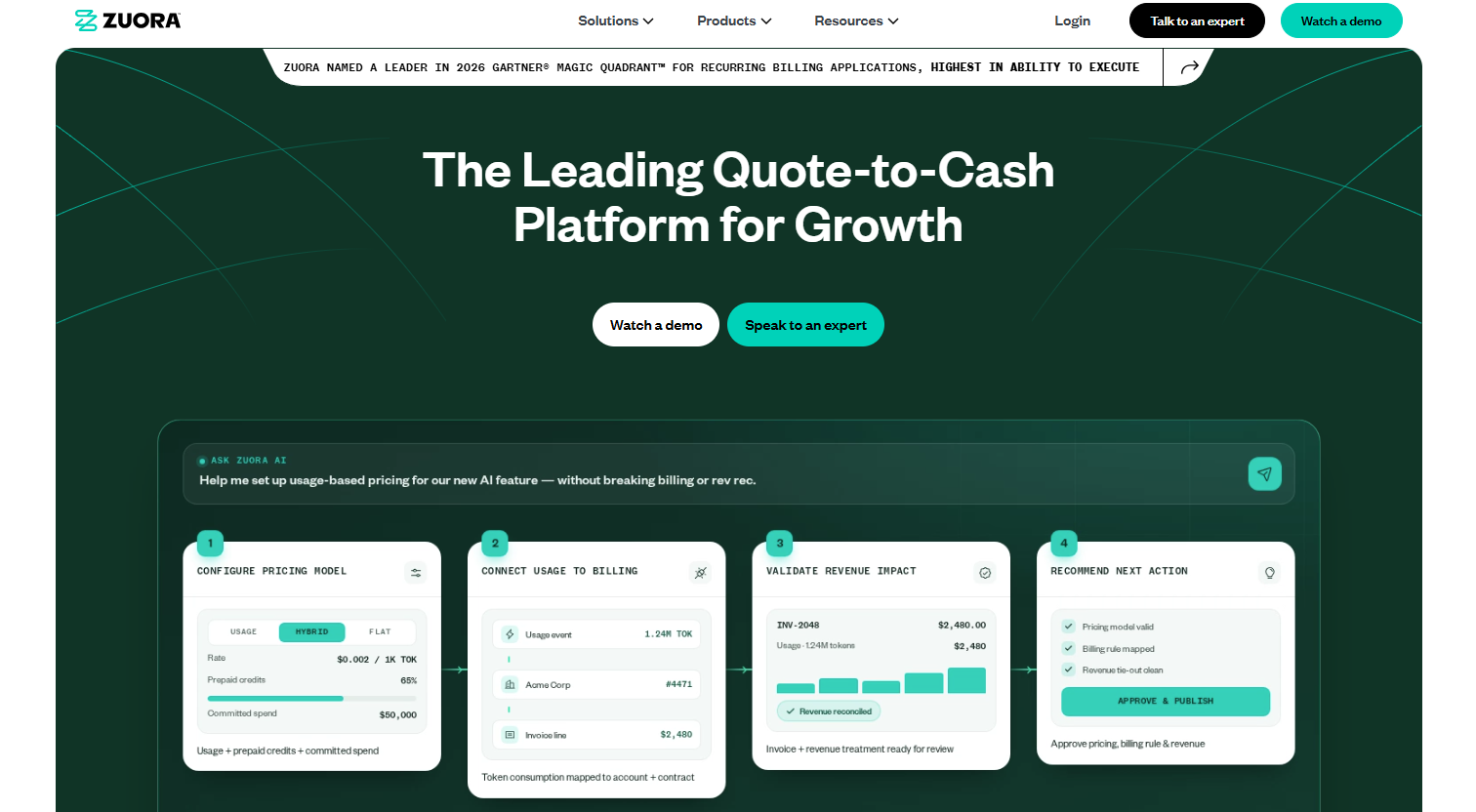
Zuora
Zuora is enterprise order-to-revenue software for complex quote-to-cash, and it now owns the Togai metering engine as well. It is designed to support large enterprises manage billing for wide product catalogs. The challenge is scope and time to value. A Zuora Billing rollout typically involves a substantial implementation program, with reported costs commonly ranging from $5,000 to $50,000-plus.
Silver Lake and GIC took the company private in February 2025, but its product and go-to-market operation remain intact.
Spreadsheets and Manual Billing
And then we arrive at the competitor almost everybody has used: spreadsheets; which are perfectly serviceable when you have a small customer base and everyone is on roughly the same kind of contract. They’re flexible, familiar, and effectively free.
Then the business grows.
Suddenly, invoicing a thousand customers manually can swallow two weeks, and by the time you’ve finished one billing cycle, the next one is already knocking at the door. Add group consolidation and currency translation, and that innocent-looking bridge file starts carrying an uncomfortable amount of responsibility.
That’s ultimately where spreadsheets stop being cheap. Although the cost of the tool itself is non-existent, the time, manual work, and risk of an error are not.
What Recurring Billing Software Costs
Recurring billing tools charge on four different bases: a share of billing volume, a merchant-of-record cut, a per-user fee, or a fee tied to recurring revenue. This is why two vendors quoting “similar” numbers can produce very different bills for the same company.
|
Tool |
Figure |
Charged on |
Checked |
|---|---|---|---|
|
Younium |
Contact-us |
Recurring revenue managed (ARR is roughly 80% of the driver), with legal-entity count a secondary factor |
See platform pricing |
|
Stripe Billing |
0.7% of billing volume |
Billing volume |
Verified 19 Aug 2026 |
|
Chargebee |
0% + 0.80% (pay-as-you-go) or $99/mo + 0.65% (commit) |
Billing volume |
Verified 19 Aug 2026 |
|
Recurly |
$249/mo + 0.9% of billing volume |
Billing volume, plus a revenue recognition add-on from $850/mo (billed annually, based on billing volume) |
Verified 19 Aug 2026 |
|
Paddle |
5% + $0.50 per checkout |
Per-transaction, merchant-of-record model |
Verified 19 Aug 2026 |
|
Zuora |
Contact-us |
Recurring revenue, plus implementation typically $5K–$50K+ |
Verified 19 Aug 2026 |
|
Zoho Billing |
Standard $50/mo ($39 annual); Premium $100/$79 |
Flat fee per organization |
Verified 10 September 2026 |
Younium's tiered model, based on ARR and legal entities, with unlimited users and API calls, is designed to be predictable as complexity grows. Roughly 80% of the price comes from the recurring revenue Younium manages, so there's no single sticker price to publish.
And that’s a good rule for this whole comparison: if a number can’t genuinely be verified, don’t pretend otherwise. Recurly's retired "free for three months" offer is a good example. Knowing what you’ll be charged on is far more useful than budgeting around yesterday’s price.
When a Payment Processor Is Enough
If all you need to do is charge cards on a fixed schedule, a payment processor can handle the job perfectly well. And if you’re a single-entity business selling straightforward monthly plans, a full recurring billing platform may be more machinery than you need.
It’s helpful to bear in mind where Younium stops too. It has no general ledger, doesn’t produce statutory accounts, and doesn’t perform intercompany eliminations. Nor is it a payment gateway or merchant of record.
So yes, Stripe handles collection, has a capable subscription model, and offers its own revenue recognition product. The boundary is that Stripe runs each legal entity as a separate Stripe account, linked through Organizations for shared reporting, with no native country-specific statutory invoice formats or accounting consolidation across entities.
To know if your current setup is keeping up with your business’ needs, run the five multi-entity questions against it, or trace ten recent international deals from contract to invoice to cash to group ARR to see where the numbers stop agreeing.
That gap is where billing complexity starts costing you. See how Younium can close it.
Frequently Asked Questions
Is Stripe Billing enough on its own?
Stripe Billing is enough when payments and a single-entity setup are the whole job. The limitation appears when you need multi-entity billing with entity-specific invoice numbering, statutory invoice formats per country, and consolidation across legal entities.
Is there free recurring billing software?
Free tiers exist at the payment-processor end of the market, but B2B billing platforms that handle contracts, tax, and revenue recognition are paid tools, priced on billing volume or recurring revenue.
How much does recurring billing software cost?
There’s no particularly useful one-size-fits-all figure because vendors charge for different things. You might pay a percentage of billing volume, a merchant-of-record cut, a per-user fee, or a fee tied to recurring revenue. It’s why it’s wise to check what the headline numbers are actually being applied to before comparing your options.